
If you love to bake, you probably know the struggle of the chaotic kitchen cabinet. You know the one—the cabinet where you try to carefully pull out a single muffin tin, only to have an avalanche of tart pans, roasting racks, and glass dishes crash down onto the floor.
We buy specialized pans for every specific recipe we find online. We purchase a heavy ceramic dish for preparing cobblers, a dark non-stick pan for brownies, and a glass dish for casseroles. But if you walk into any professional bakery, you won’t see a rainbow of different materials and oddly shaped dishes. You are going to see stacks and stacks of simple, shiny, silver metal.
Specifically, you’ll see pure aluminum.
Professional bakers know a secret that home cooks are finally catching onto: you don’t need fifty different pans. You just need a couple of incredibly well-made basics. When it comes to baking everything from the fudgiest, thickest brownies to the crispiest, thinnest cookies, your best friends are going to be a classic aluminum sponge tray and a reliable aluminum biscuit tray.
Let’s talk about why these simple pieces of metal are the hardest-working tools in the kitchen and how to understand exactly what kind of tray you need.
The Magic of Pure Aluminum
Why do professionals swear by aluminum? The answer lies in the fundamental principles of kitchen physics.
Aluminum is an incredible conductor of heat. When you put an aluminum pan in the oven, it heats up quickly and, more importantly, it heats evenly. Have you ever baked a batch of cookies where the ones in the corners burned while the ones in the middle were raw? That usually happens when you use a thin, cheap pan made of a material that creates “hot spots.”
Aluminum eliminates that. It distributes the heat across the entire surface. Furthermore, because it’s a light-colored metal, it reflects heat rather than absorbing it heavily the way dark non-stick pans do. This prevents the bottoms of your baked goods from getting too dark before the centers are cooked through.
Deep Dive: The Aluminum Sponge Tray
If you want volume, you need a sponge tray. These trays are characterized by their higher side walls—typically around 2 inches (or 50 mm).
An aluminum sponge tray is designed to hold batter that needs room to grow. Obviously, as the name suggests, it is the absolute perfect vessel for a classic, bouncy sponge cake. The straight, tall sides support the cake as it rises, giving you those clean, sharp edges that look completely professional.
But its uses go way beyond cake.
Think about brownies. If you like thick, bakery-style brownies (the kind that are intensely fudgy in the middle and have that crackly, papery top), you need the depth of a sponge tray.
It’s also your go-to for savory baking. A thick, dimpled focaccia bread absolutely thrives in an aluminum sponge tray. The metal gets hot enough to fry the bottom of the dough in olive oil, creating an incredible crust, while the high walls keep the dough contained as it proofs and bakes.
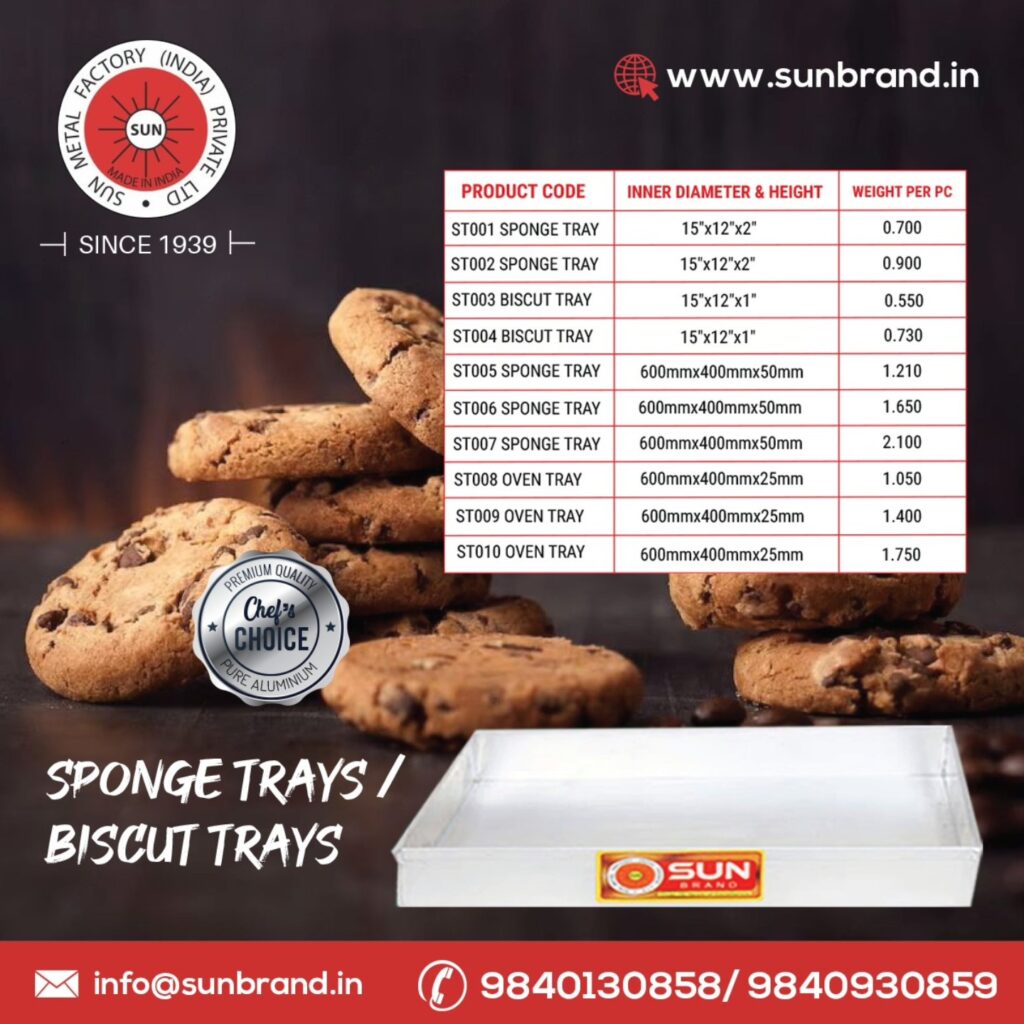
Professional-grade equipment, such as Sunbrand’s lineup, demonstrates their sizing for serious baking. Their ST001 and ST002 sponge trays come in a highly versatile 15″ x 12″ x 2″ size. If you are baking for a crowd or running a commercial kitchen, step up to the ST005, ST006, and ST007 models, which are a massive 600 mm x 400 mm x 50 mm.
Deep Dive: The Aluminum Biscuit Tray (and Oven Tray)
Now, let’s talk about the flat stuff.
While high walls are great for cakes, they are actually terrible for cookies and biscuits. High walls block the hot air in the oven from circulating freely over the top of your baked goods. If you try to bake cookies in a deep pan, the sides of the pan create a mini-climate that steams the dough rather than baking it, preventing that beautiful golden-brown caramelization.
That is exactly why an aluminum biscuit tray has low profiles—usually about 1 inch (or 25 mm) high.
This low edge is enough to keep your baking parchment from sliding off and to contain any minor grease from spreading, but it allows the hot oven air to wash directly over your cookies, scones, biscuits, or roasting vegetables. This ensures an even, crisp bake every single time.
Looking again at the Sunbrand specifications, their ST003 and ST004 biscuit trays match the footprint of the smaller sponge trays (15″ x 12″) but drop the height down to just 1 inch. For heavy-duty commercial use, their Oven Trays (ST008, ST009, and ST010) offer a massive 600 mm x 400 mm surface area with a low 25 mm lip, perfect for sliding dozens of cookies into a commercial oven at once.
Decoding the Specs: Why Does Weight Matter?
If you look closely at commercial baking catalogs, you might notice something confusing. The ST001 and ST002 sponge trays from Sunbrand, for instance, are precisely the same size (15″x12″x2″). Yet, the ST001 weighs 0.700 kg, and the ST002 weighs 0.900 kg.
Why the difference?
- Thickness: In the manufacturing world, the thickness is often referred to as the “gauge” of the metal. A heavier pan means thicker aluminum.
- Lighter Trays: A lighter tray (like the 0.550 kg ST003 biscuit tray) heats up incredibly fast and cools down almost instantly when you take it out of the oven. This is ideal for delicate baked goods, where you want the baking process to stop the second it leaves the heat.
- Heavier Trays: A heavier tray (like the 0.730 kg ST004 biscuit tray or the hefty 2.100 kg ST007 commercial sponge tray) takes a little longer to heat up, but it holds that heat beautifully. More importantly, thicker aluminum is much less prone to warping. If you’ve ever heard a loud “POP” from your oven and found that your baking sheet has twisted diagonally, it’s because the metal was too thin to handle the temperature change. Heavier commercial trays won’t do that.
Choosing between them just depends on how hard you plan to use them and what you are baking.
Investing in Quality
If you’re going to declutter your kitchen and buy versatile pans, you want to buy from experts.
Sunbrand (Sun Metal Factory India Pvt. Ltd.) is a fantastic example of heritage quality. They’ve been manufacturing in India since 1939. When a company has been making baking equipment for over 80 years, they’ve figured out exactly what chefs need.
Their trays are marked as “Chef’s Choice” for a reason. They use pure aluminum, skipping the fancy (and easily scratched) non-stick coatings in favor of raw performance and durability. A pure aluminum tray will last you decades. It might get a few scratches or stains over the years—bakers call that a “patina”—but it will never peel, flake, or lose its ability to conduct heat perfectly.
You don’t need a kitchen that looks like a retail store to bake beautiful food. By understanding the tools of the trade, you can do more with less.
Grab a high-walled sponge tray for your brownies, focaccias, and birthday cakes. Grab a low-walled biscuit tray for your cookies, roasted veggies, and pastries. If you wash them by hand with warm, soapy water (not in the dishwasher, which causes discoloration), these trays will last a lifetime.