
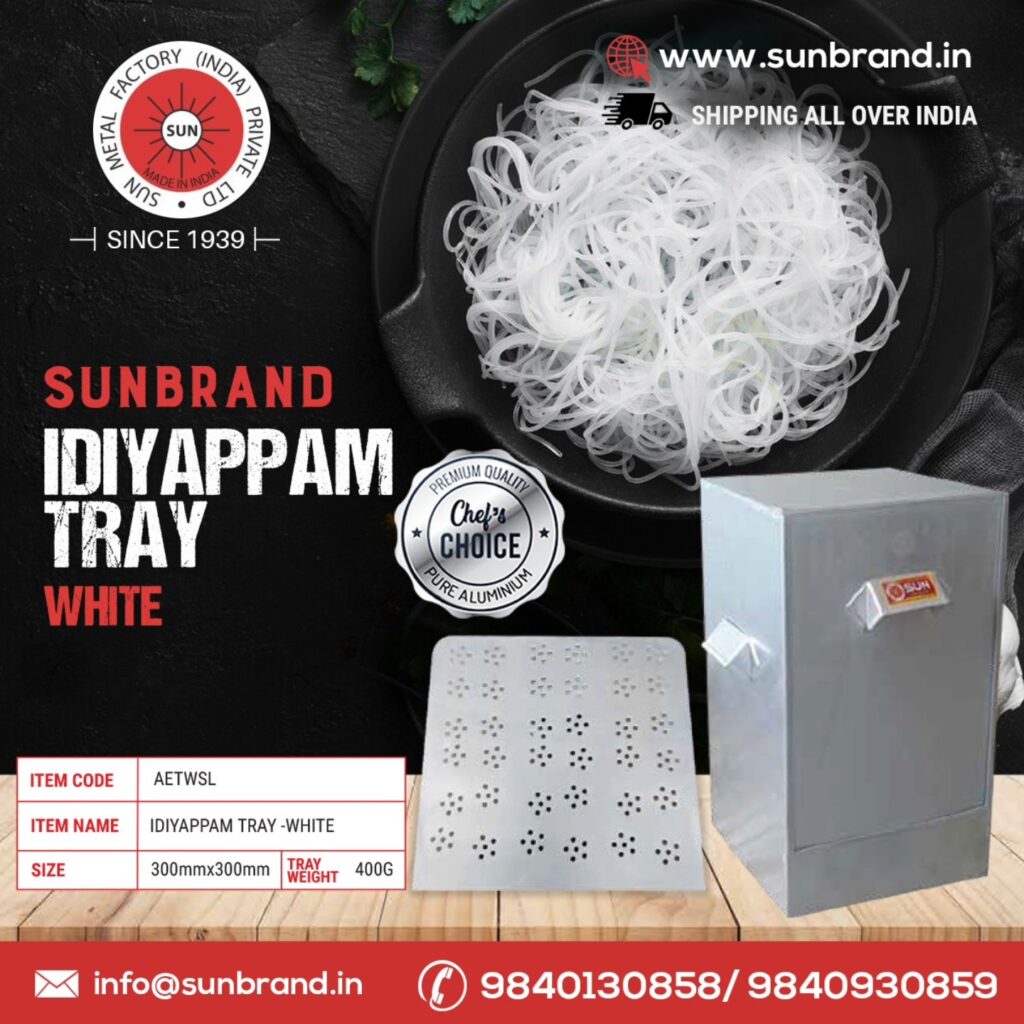
In a professional kitchen, especially in South Indian, Kerala, and catering restaurants, every piece of equipment has a direct impact on how quickly and efficiently food is prepared and how delicious it tastes. Idiyappam may seem straightforward, but making it in giant batches all the time takes a lot of care. Choosing the proper size idiyappam tray that fits your production needs is one of the most important things that keeps this consistency going.
The appropriate tray size not only makes sure that the food steams evenly, but it also speeds up the workflow, lowers the amount of labor that staff has to do, improves the food taste, and saves fuel. We make perforated idiyappam trays for restaurants and caterers all throughout India, so we know the small but important things to think about while choosing the ones that will really help your business.
Knowing What Idiyappam Trays Are Used For
Idiyappam trays are made such that the steaming string hoppers cook uniformly without sticking, breaking, or clumping. The design of the perforations, base thickness, width, height, and material grade all have an effect on how long it takes to steam and how excellent the texture is.
Most restaurants are unaware that a variation of just 1–2 cm in the size of the tray can impact the following aspects:
- The passage of steam
- Speed of production
- The consistency of idiyappam
- How long the tray will last
- Making the most of kitchen space
That’s why picking the correct size isn’t a guess; it’s a well-thought-out choice depending on how much work you can handle.
Different Kinds of Idiyappam Trays
You need to know what kinds of trays are available before you pick a size:
Regular Idiyappam Trays: Used in small to medium-sized restaurants that serve idiyappam as part of their menu.
Catering trays that can handle a lot of weight: These larger trays are great for making a lot of idiyappam at once, which is great for caterers, wedding halls, and festival orders.
Trays for Idiyappam Made of Aluminum: Lightweight, heats up quickly, and doesn’t cost much—best for everyday restaurant use.
Idiyappam trays made of stainless steel: excellent-end kitchens and five-star hotels love it because they are excellent quality, long-lasting, and clean.
Trays with custom sizes: Made to accommodate certain steamers, bulk cookers, and industrial idiyappam equipment.
Knowing the Standard Sizes of Idiyappam Trays
Different manufacturers make trays in different sizes, but the most popular sizes used by restaurants are
8-inch tray: Good for small restaurants and tiffin establishments
10-inch: Medium-sized restaurants that sell a lot of idiyappam. 12-inch:14-inch: Busy restaurants and mid-size caterers; 16-inch and up: High-volume kitchens Bulk caterers and industrial production
Each size has a purpose, and picking the wrong one might waste steam, cook food unevenly, and slow down operations.
Things to think about when picking a tray size
The number of customers you get
- Low footfall: Smaller trays work well.
- Medium footfall: Medium trays are the finest choice.
- High footfall or peak hours: Bigger trays guarantee that a lot of food is served without slowing down service.
The size and layout of your kitchen: No matter how fantastic they are, big trays won’t work in a small kitchen.
Some important things to think about are
- Room inside the steamer
- Height of the rack
- Space for loading and unloading
- Moving staff
Compatibility of Steamer Sizes
Your idiyappam tray needs to fit your steamer exactly. Even a 1-inch difference causes:
- Loss of steam
- Wasting fuel
- Cooking that isn’t even
Daily Production Requirement
Figure out how many idiyappams you sell every hour.
- If you sell 200 to 300 per hour, 12-inch trays are the best choice.
- If you sell between 400 and 700 per hour, 14-inch trays are better.
- If you sell more than 1000 an hour, we suggest using industrial 16-inch trays.
Productivity of Staff
The correct tray size can minimize loading time by 20–30%, especially during busy times. Larger trays cut down on manual handling, which makes workers work better.
Choosing the Right Tray Size for Your Steamer
Different trays are needed for different steamers: many eateries have them. For the finest stacking, use trays that are 10 to 12 inches wide.
Steamers that are horizontal
- Caterers utilize this a lot.
- It fits trays that are 12 to 16 inches wide.
- Steamers that use gas
- The heat is high, thus thinner trays are better.
Electric Steamers
The heat is slower; thus, thicker trays help the food cook evenly.
Material Matters: How to Pick the Right Tray Material
Trays made of aluminum
- Not heavy\
- Heats up quickly
- Easy on the wallet
Perfect for eateries that serve Tamil/South Indian breakfast every day
Trays made of stainless steel (SS 202/304)
- Very long-lasting
- No rust
- Preferred in high-end kitchens
- Keeps up with sanitary standards
Aluminum that has been hard anodized
- High-quality finish
- Long life span
- Great for caterers and light industrial use
How thick and durable the tray is
The thickness of the tray affects how long it lasts.
- Application: Recommended Gaug
- Small restaurants: 20-gauge
- Mid-size restaurants: 18 gauge for 16-gauge caterers
- Units for industry 14 gauge
A thicker tray stops bending, warping, and wear before it happens.
How many idiyappams can each size of tray hold?
Approximate Capacity of Tray Size
- 8 inches3–5 idiyappams
- 10 inches6–8 idiyappams for 12 inches, 8–12 idiyappams for 12 inches
- 14-inch: 12–16 idiyappams 16-inch: 18–24 idiyappams
This lets you figure out how much work you can do in an hour.
Stackability:
An Important Feature for Efficiency
- Your steamer must fit the trays completely. Stacking wrong causes:
- Steam that goes to waste
- Cooking that isn’t even
- More gasoline used
This problem can be fixed with professional-grade trays that have been tested by the manufacturer.
Special Needs for Caterers
Caterers need:
- Trays with more space
- Material that is thicker than usual
- Uniform holes for faster steaming
- Custom sizing to fit commercial steamers
Caterers like 14- to 16-inch trays better since they cut down on cooking time when they have a lot of orders.
Following hygiene and food safety rules
Restaurants should pick trays that are
- Compatible with FDA standards
- Not rusting
- Simple to clean
- Not reactive
- A smooth finish keeps food from sticking.
- For kitchens that are sensitive to hygiene, stainless steel trays are excellent.
Picking Between Ready-Made and Custom Trays
Ready-Made Trays
- Cheap
- Faster delivery
- Works with regular steamers
- Trays Made Just for You
- Fits your steamer perfectly
- Thickness that fits your needs
- Customized size and hole size
If your steamer is built in your area, custom trays are usually the best choice.
Cost vs. Value: Make the Right Choice
A tray that is used every day must be able to withstand very hot temperatures and constant stacking. Cheap trays flex, warp, and break quickly, so you have to buy them again and again. Over time, premium trays cost less to replace, which makes them a better investment.
How to Pick the Right Size for Your Idiyappam Tray
Selecting the right size for your idiyappam tray is crucial and should not be taken lightly. A well-chosen tray speeds up production, makes sure steaming is correct, cuts down on fuel use, and makes food more consistent. Choosing the correct size and substance will greatly affect how well your business runs, whether you run a small tiffin center, a busy restaurant, or a huge catering firm.
As a manufacturer, we still say: always choose trays based on the number of users, steamer size, kitchen layout, and food quantity. A perfectly matched tray is the secret to success in the kitchen.