
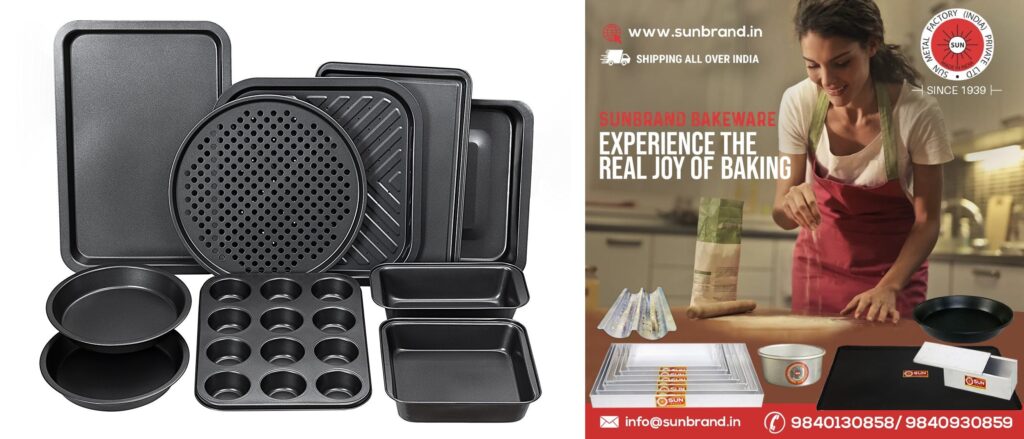
Since hard anodized bakeware dethroned non-stick bakeware and entered the market, there has been a big discussion between the two types of bakeware. Although they are both constructed of the same materials—copper, stainless steel, or aluminum—their manufacturing processes give them distinct qualities. If you’re looking for a new bakeware set then, this article will help you decide which type of bakeware is best for your kitchen.
What is hard-anodized bakeware?
The base of hard anodized bakeware is aluminum. An electric current is used to create an anodized coating over the aluminum rather than putting a PTFE coating. This layer normally has a thickness of less than 5 micrometers.
The surface’s non-reactivity to any food is its key benefit. Therefore you can cook acidic food without worrying about hurting the surface or metals leaching into your food, unlike cast iron and stainless steel.
To buy Hard-anodized bakeware sets Click Here https://sunbrand.in/bakery-products.php
How is anodized bakeware made?
Cookware that has been anodized, also known as hard anodized cookware, begins with a base made of aluminum or an aluminum alloy that has been dipped into a chemical bath and then shocked with electricity. Pots and pans are resistant to corrosion, scratching, and other types of damage because they have a much thicker protective covering than the original metal while yet retaining aluminum’s excellent heat conduction. Cookware that has been anodized distributes heat evenly and does not react to acidic foods. Most of them have substantial bases, which balance the pan on the stovetop and lengthen the lifespan of each pot.
| Aspects to consider | Hard- anodized bakeware | Non-stick bakeware |
| Stick Resistance | Hard Anodized Pans have some non-stick properties, it is frequently necessary to use oil or butter to prevent food from sticking. | Non-stick is the ideal pan for home cooks who are concerned about their health because it doesn’t require any butter or oil when cooking. |
| Durability | Cookware that has been hard anodized is significantly more durable. The anodized layer doesn’t come off as easily as nonstick, even when using metal spoons. | The coating on nonstick cookware is quite sensitive. No of the brand, most non-stick cookware’s coating peels off after two to three years. |
| warping | They are generally thicker hence prone to less warping | Prone to warping |
| Durability to Abrasion | Hard-anodized bakeware can withstand the use of metal spoons and abrasive scrubs. But reducing its usage can minimize its risk of durability | Using metal spoon can increase its risk of durability |
| Safety | Cookware made of hard anodized aluminum is non-reactive in contrast. Even when overheated, they are extremely heat resistant and do not release any harmful vapors. | When heated up, nonstick cookware can release harmful gasses. Consuming nonstick coating flakes is a risk of using nonstick cookware, however it does not provide a health threat |
| Performance | Aluminum serves as the foundation for all hard anodized cookware. This cookware often doesn’t have any hotspots because they distribute heat evenly. | They provide equal, constant heating without hot spots because to its Steel Clad core. |
| Clean and maintenance | Hard-anodized bakeware is easy to clean but is not suitable to wash in a dishwasher. The handles of hard anodized pans are made of stainless steel, which won’t melt at extreme heat. Furthermore, even while wearing oven mitts, they are simple to hold. | Just rinse with warm water and wash with a mild dish solution to clean and retain non-stick. As abrasive sponges and cleaners can harm the nonstick coating, avoid using them. |