
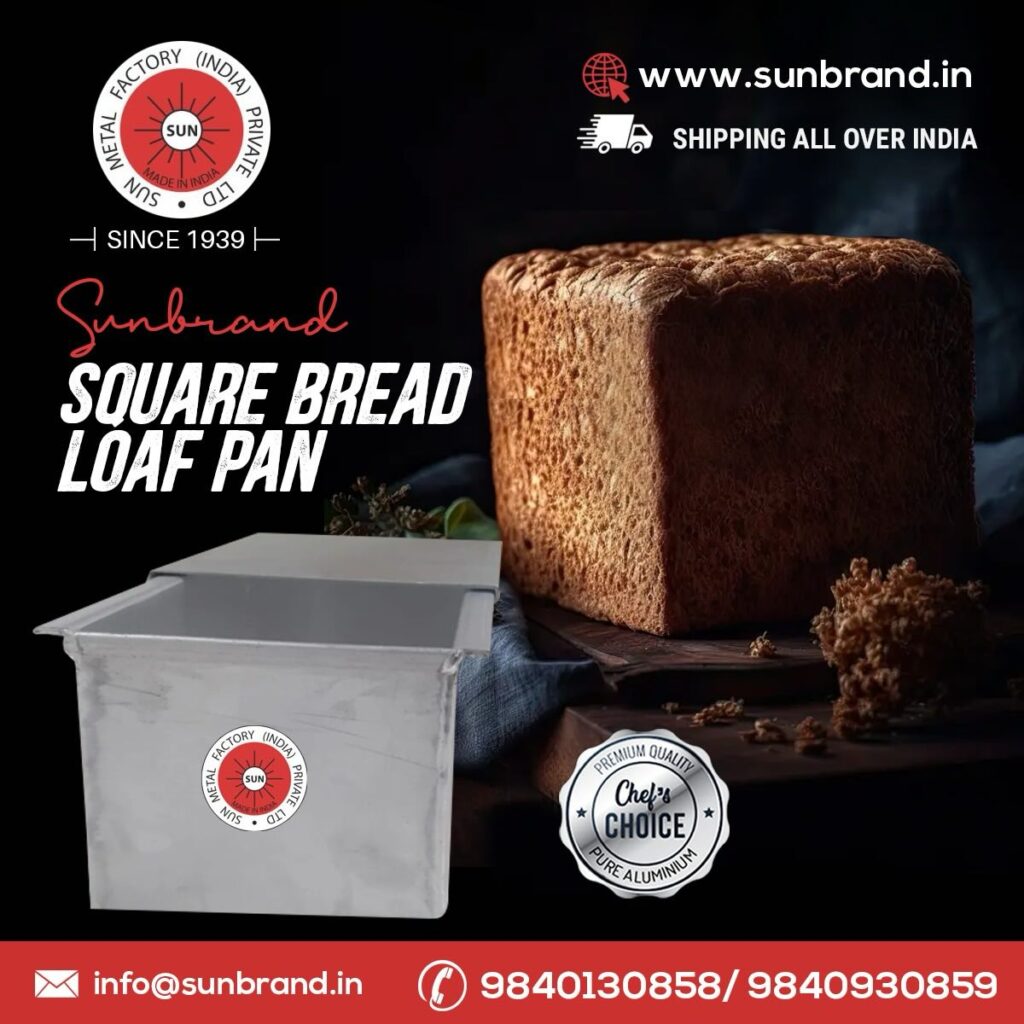
Every single day in our manufacturing workshop, we talk to bakers who are completely frustrated with their bread. They tweak their yeast ratios, switch flour brands, and obsess over ambient humidity. But when they show us pictures of their uneven, bulging loaves, we usually spot the culprit right away. It’s not their recipe; it’s their pan.
While ingredients are undeniably important, the vessel you bake that dough in dictates exactly how it will behave in the oven. Lately, we’ve seen a massive surge in people making a simple swap that transforms their baking overnight: upgrading to a square bread loaf pan.
If you’ve ever wondered why your homemade sandwich bread doesn’t look or slice like the loaves from a professional bakery, you are about to discover the secret. Let’s look at how pan design completely alters bread texture, crust, rise, and appearance.
The Anatomy of a Square Bread Loaf Pan
When we design and manufacture a square bread loaf pan, we are aiming for geometric precision. Unlike the familiar tins with flared sides, a square pan features straight, 90-degree vertical walls and sharp corners. Often called Pullman pans—especially when they come with a sliding lid—they physically force your expanding dough to bake into a perfect rectangular prism.
To handle the unique way heat interacts with these sharp corners, we craft these pans from highly conductive materials. We typically use aluminized steel for fast, even heating, or heavy-duty carbon steel for commercial bakeries that are churning out hundreds of loaves a day. We also apply high-quality non-stick coatings because trying to pry a loaf out of a perfect 90-degree corner without tearing the crust is a nightmare no baker should face.
These square pans are the ultimate tool for sandwich bread, delicate Japanese milk bread, and those perfectly symmetrical bakery-style loaves.
Why Did We All Grow Up with Traditional Pans?
If square pans are so great, why does nearly every home kitchen have a traditional, rounded-edge bread pan?
The answer comes down to mass production and convenience. Decades ago, traditional pans became the household standard because their sloped sides make them incredibly easy for factories to stack, ship, and display on store shelves. The flared design also means baked goods slide out almost effortlessly.
These classic pans are fantastic. They are exactly what you want when making banana bread, a rustic white loaf, or your grandmother’s famous meatloaf. But that sloping design means the top of your bread will always mushroom out, leaving you with a loaf that is significantly wider at the top than at the base.
The “Aha!” Moment: What Happens When You Switch
When our customers finally test a square bread loaf pan, the feedback is almost always immediate. Here are the biggest differences you will notice the moment you slice into your first bake.
Perfect Shape for Pain-Free Sandwiches
If you are a parent packing school lunches, you know the struggle. You slice into a traditional loaf, and the bottom pieces are tiny, while the middle slices are massive. Deli meat hangs off the edges, and the sandwich falls apart in the lunchbox. A square pan solves this homeowner pain point instantly. By keeping the sides perfectly straight, every single slice from end to end is exactly the same size.
A Totally Different Crust Profile
Because of the sharp geometry, a square pan concentrates oven heat right at the edges, giving you beautifully distinct, slightly crisper corners. Traditional pans diffuse that heat along their gentle curves, which yields a softer, more uniform crust along the sides.
Controlling the Rise and Crumb Structure
In a traditional flared pan, your dough has room to expand outward and upward, creating that classic domed top. In a square bread loaf pan, the high vertical walls trap the dough. It has nowhere to go but straight up. This restricted, vertical rise actually packs the internal crumb structure closer together, resulting in a tighter, incredibly uniform texture with no massive air bubbles.
Eliminating Bakery Waste
For commercial bakers, inconsistent slices eat into profits. You can’t sell an uneven end-piece as a premium cafe sandwich. Bakeries rely heavily on square pans because the slice consistency means zero waste. Every piece of bread is usable, stackable, and sellable.
The Science of the Bake: What’s Happening Inside
From an engineering perspective, a baking pan is just a tool to control thermal conduction. The shape of the metal completely alters the airflow and temperature around your dough.
In a square pan, those tight 90-degree corners act like little heat magnets, pulling the ambient oven heat deeply into the center of the dough. This ensures the middle of the loaf bakes completely before the top has a chance to over-brown and burn. Furthermore, those tall, straight walls trap the steam escaping from the sides of the dough. This built-in moisture retention is exactly why you get much fluffier, pillowy bread in a square pan compared to a standard tin.
Texture and Taste: Match Your Dough to Your Pan
Because the hardware actually changes the eating experience, it helps to know which pan to reach for.
When you use a square bread loaf pan, you get a softer, tighter crumb and superior moisture retention. Because the structure is so uniform, it locks in hydration, meaning your bread will actually stay fresh on the counter a few days longer. It is the absolute best choice for:
- Japanese milk bread (Shokupan)
- Everyday sandwich bread
- Rich brioche
- Classic Pullman loaves
When you use a traditional pan, you get a beautiful, rustic appearance with an airier, more open dome structure. It feels delightfully homemade. It remains our top recommendation for:
- Banana, zucchini, and pumpkin breads
- Heavy whole wheat or rye loaves
- Rustic, crusty white breads
Square vs. Traditional: The Breakdown
| Feature | Square Bread Loaf Pan | Traditional Pan |
| Slice Uniformity | Excellent (Every slice matches) | Moderate (Wider at the top) |
| Sandwich Friendly | High (Perfect for lunchboxes) | Medium |
| Crust Crispiness | Distinct, crisp corners | Balanced and soft sides |
| Aesthetic | Professional bakery look | Classic, cozy, homemade |
| Learning Curve | Requires measuring dough volume | Very forgiving |
The Speed Bumps: Common Mistakes We See
As the folks making the pans, we field a lot of troubleshooting emails. If you are making the jump to a square pan, watch out for these common missteps:
- Overfilling the dough: Because the walls are straight, if you put too much dough in the pan, it will aggressively mushroom over the top and ruin your perfect square shape.
- Skimping on the butter: A 90-degree corner will absolutely grip your dough if you don’t grease it thoroughly. Always butter the corners well, or use a good baking spray.
- Baking too hot: The deep corners need steady, consistent heat. If your oven is too hot, the edges will dry out before the dense center is fully baked.
- Rushing the cooling process: The dense, moisture-rich crumb from a square pan takes a little longer to set. Let it cool completely on a wire rack so the bottom doesn’t get soggy.
Our Workshop Tips for the Perfect Loaf
To get the absolute best results from your new bakeware, keep your dough hydration around 65% for standard sandwich bread. This creates just enough steam to work perfectly with the straight walls.
When proofing, keep an eye on the height. Let the dough rise until it is just about one inch from the rim of the pan. If your pan came with a sliding lid, slide it on when the dough is about three-quarters of the way full. Finally, place the pan on the lower-middle rack of your oven so those bottom corners get plenty of heat without scorching the top.
Is the Upgrade Really Worth It?
When customers ask us if buying another pan is really necessary, we always ask them what they are trying to bake.
If you are a home baker tired of your sandwiches falling apart, or if you just want to recreate that ultra-soft, uniform grocery store bread without the chemical preservatives, a square bread loaf pan is the single best investment you can make for your kitchen. For professional bakers, it isn’t even a question—it is a mandatory tool for portion control, consistency, and profitability.
While a heavy-duty, engineered square pan might cost a few dollars more than a basic stamped tin from the grocery store, the durability and the standardized, flawless loaves it produces make it worth every penny.
The dramatic difference between these two pans isn’t a marketing trick; it is simply how baking physics works. A square bread loaf pan forces a tight, vertical crumb structure, traps essential moisture, and gives you mathematically perfect slices every single time. Traditional pans will always be our favorite for a warm loaf of banana bread, but they simply cannot compete when it comes to sandwich-making.
If you are chasing that perfect bakery-style sandwich loaf, stop fighting your recipe. Change your pan, and you might just change the way you bake forever.